Electron spin-dependent chemical reactions
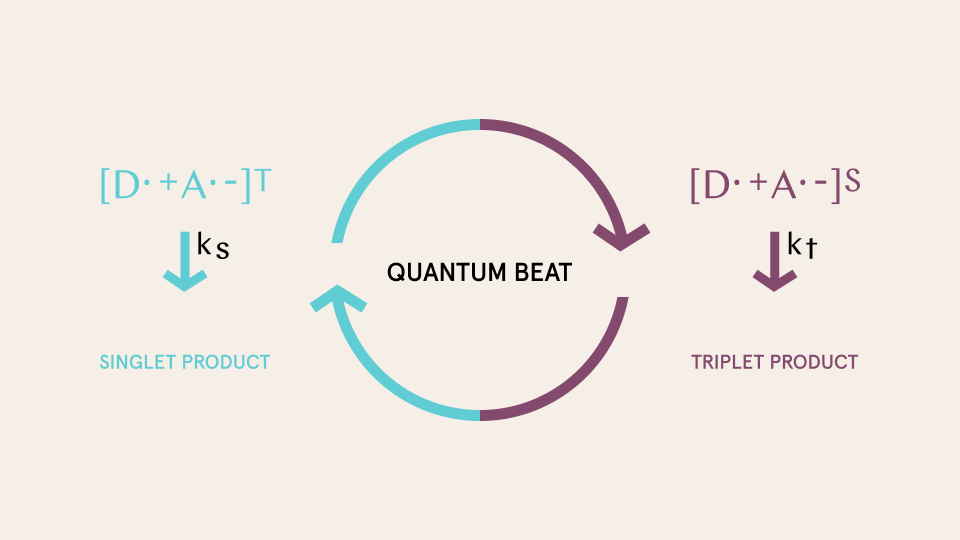
When excited electrons are subjected to a weak magnetic field, they can become entangled with nearby electrons, yielding what is called a “radical pair.” Radical pairs oscillate between two superpositions states, the singlet and triplet state. This oscillation, known as a “quantum beat,” affects chemical reaction rates and fluorescence rates.
The radical pair mechanism is known to operate, for instance, in certain types of chemical reactions. What is not known is whether it plays an important role in biological function. The fact that the radical pair mechanism affects fluorescence rates makes it possible to study it, however, using the right type of instrumentation.
The TIRF Microscope

What it is and how we will use it
At the Los Angeles lab, QBI scientists are building a Total Internal Reflection Fluorescence (TIRF) microscope, equipped with magnetic coils to allow for the application of weak magnetic fields, and a single photon detector. Together, the microscope enables optically detected magnetic resonance (ODMR) with both second and nanosecond resolution. This instrument can be used to probe the effects of weak magnetic fields in biological systems at biological and quantum time-scales.
Our scientists will shine a laser onto a biological sample at room temperature. This will excite electrons in proteins, yielding entangled radical pairs, which will decay at a rate that depends on the proportion of singlet and triplet states. Oscillations in the resulting fluorescence pattern will correspond to the duration of the quantum state, allowing us to detect if quantum states last long enough inside cells to be biologically relevant.
Bacterial Transcriptomics

What it is and how we will use it
At our satellite lab in Maryland, one of our scientists is running side-by-side experiments to observe the effects of the Earth’s magnetic field on bacteria such as E. coli. Once the experiments are debugged and undergo multiple replications, it is then possible to perform transcriptomics analysis on the bacteria to see which transcription factors are turned on and off by the presence and absence of the Earth’s magnetic field.
The behavior of radical pairs, which will be detected by the TIRF microscope, is sensitive to weak magnetic fields, such as the Earth’s. If weak magnetic fields also alter transcription factors inside cells, and thereby alter gene expression, this provides a potential causal pathway from weak magnetic fields through the radical pair mechanism to gene expression and, ultimately, to cell function.
Quantum biology is the future
We envision a world where the effects of weak magnetic fields, including those produced by a cell phone or weaker, are well-understood and used precisely to treat medical conditions, enhance biomanufacturing, and more. Join us in our mission to advance the field of quantum biology and lay the foundation for powerful, cheap, non-invasive electromagnetic interventions!